


SFP28-25G-SR 25G SFP28 SR 850nm 100m LC MMF DDM Transceiver Module
Duplex SFP28 Transceiver
LC connector receptacle
Data Rate up to 25.78125 Gb/s
850nm VCSEL laser and PIN photo-detector
Maximum link length of 70m on OM3 MMF and 100m on OM4 MMF
◆ Hot-pluggable SFP28 form factor
◆ Supports 25.78125Gb/s bit rate
◆ Maximum link length of 70m on OM3 MMF and 100m on OM4 MMF
◆ 850nm VCSEL laser and PIN photo detector
◆ Internal CDR on both Transmitter and Receiver channel
◆ Operating environment temperature range: 0 ~ +70℃
◆ Single 3.3V power supply
◆ Low power dissipation: <1.0W
Features
◆ Duplex LC connector Support up to 28Gb/s bit rates
◆ Hot-pluggable SFP footprint
◆ Built-in digital diagnostic functions
◆ Internal CDR on both Transmitter and Receiver channel
◆ Transmission distance up to 100m on OM4 MMF
◆ Single power supply 3.3V
◆ RoHS6 compliant
◆ Operating temperature range Commercial :0℃ to 70℃ Industrial :-40℃ to 85℃
◆ Power consumption <1.0W
Applications
◆ Data Center
◆ 25GBASE-SR Ethernet
◆ 32G Fiber Channel Applications
◆ Servers, Switches, Storage and Host Card Adapters
|
Optical transmitter Characteristics |
||||||
|
Parameter |
Symbol |
Min |
Typical |
Max |
Unit |
Notes |
|
Launched Power (avg.) |
POUT |
-8.4 |
|
2.4 |
dBm |
|
|
Optical Power OMA |
POMA |
-6.4 |
|
3 |
dBm |
|
|
Operating Wavelength Range |
λC |
840 |
850 |
860 |
nm |
|
|
Spectral Width (RMS) |
∆λ |
|
|
0.6 |
nm |
|
|
Extinction Ratio |
ER |
2 |
|
|
dB |
|
|
Transmitter and Dispersion Penalty |
TDP |
|
|
4.3 |
dB |
|
|
Optical Output Power after TX Disable |
PDIS |
|
|
-30 |
dBm |
|
|
Relative Intensity Noise |
RIN |
|
|
-128 |
dB/Hz |
|
|
Optical Return Loss Tolerance |
ORL |
|
|
12 |
dB |
|
|
Optical Receiver Characteristics |
||||||
|
Parameter |
Symbol |
Min |
Typical |
Max |
Unit |
Notes |
|
Wavelength Range |
λC |
840 |
850 |
860 |
nm |
|
|
Average Receiver Power |
Pmax |
-10.3 |
|
2.4 |
dBm |
|
|
Receiver Sensitivity (Average power) |
Psen |
|
|
-10.3 |
dBm |
1,2 |
|
LOS De-Assert |
LOSD |
|
|
-13 |
dBm |
|
|
LOS Assert |
LOSA |
-30 |
|
|
dBm |
|
|
LOS Hysteresis |
|
0.5 |
|
|
dB |
|
|
Receiver Reflectance |
Rr |
|
|
-12 |
dB |
|
Notes:
1. Measured with a PRBS 231-1 test pattern, @25.78125Gb/s, BER<5E-5.
2. Minimum value is informative, equals min Tx OMA with infinite ER and max channel insertion loss.
Pin definition
The SFP28 modules are hot-pluggable. Hot pluggable refers to plugging in or unplugging a module while the host board is powered. The SFP28 host connector is a 0.8 mm pitch 20 position right angle improved connector specified by SFF-8431, or stacked connector with equivalent electrical performance. SFP28 module contacts mates with the host in the order of ground, power, followed by signal as illustrated by Figure 1 and the contact sequence order listed in Table 1.
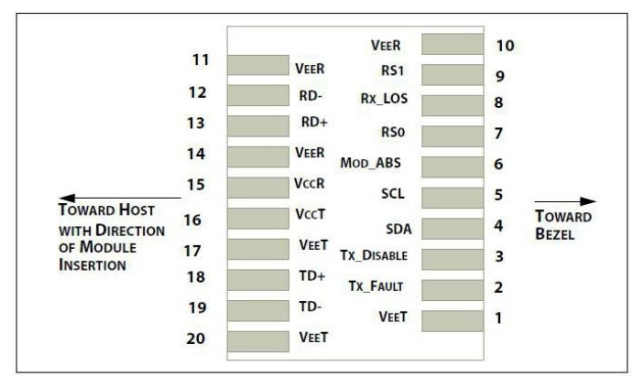
Figure 1 SFP28 Pad Assignment Top View
|
Pin No |
Symbol |
Name/Description |
Power Seq. |
Note |
|
1 |
VeeT |
Transmitter Ground |
1st |
1 |
|
2 |
TX_Fault |
Transmitter Fault |
3rd |
2 |
|
3 |
TX_Disable |
Transmitter Disable |
3rd |
3 |
|
4 |
SDA |
2-Wire Serial Interface Data Line |
3rd |
4 |
|
5 |
SCL |
2-Wire Serial Interface Data Line |
3rd |
4 |
|
6 |
Mod_ABS |
Module Absent, Connect to VeeT or VeeR in Module |
3rd |
5 |
|
7 |
RS0 |
No connection required |
3rd |
6 |
|
8 |
RX_LOS |
Receiver Loss of Signal indication |
3rd |
7 |
|
9 |
RS1 |
No connection required |
3rd |
8 |
|
10 |
VeeR |
Receiver Ground |
1st |
1 |
|
11 |
VeeR |
Receiver Ground |
1st |
1 |
|
12 |
RD- |
Receiver Inverted DATA out. AC Coupled. CML-O |
3rd |
9 |
|
13 |
RD+ |
Receiver Non-inverted DATA out. AC Coupled. CML-O |
3rd |
9 |
|
14 |
VeeR |
Receiver Ground |
1st |
1 |
|
15 |
VccR |
Receiver Power Supply |
2nd |
10 |
|
16 |
VccT |
Transmitter Power Supply |
2nd |
10 |
|
17 |
VeeT |
Transmitter Ground |
1st |
1 |
|
18 |
TD+ |
Transmitter Non-Inverted DATA in. AC Coupled. CML-I |
3rd |
11 |
|
19 |
TD- |
Transmitter Inverted DATA in. AC Coupled. CML-I |
3rd |
11 |
|
20 |
VeeT |
Transmitter Ground |
1st |
1 |
Power Seq.: Pin engagement sequence during hot plugging.
Notes:
1. The module signal ground contacts.
2. This pin is an open drain/collector and should be pulled up to Vcc-host in the host with a 4.7k~10k Ohm resistor.
3. This pin should be pulled up to VccT with a 4.7k~10k Ohm resistor in modules.
4. SDA&SCL (IIC) are needed pull up 4.7k~10k Ohm resistors on host board.
5. Mod_ABS is connected to VeeT or VeeR in the SFP28 module.
6. Rate Select 0, no connection required.
7. Module RX_Los of signal indication need pull up 4.7k~10k Ohm resistor on host board.
8. Rate Select 1, no connection required.
9. RD -/+: These are the differential receiver outputs. They are CML AC-coupled with 100 Ohm terminal resistor matching internal.
10. VccR and VccT are the receiver and transmitter power supplies.
11. TD-/+: These are the differential transmitter inputs. They are CML AC-coupled with 100 Ohm terminal resistor matching internal
Ordering information
|
PART NO. |
Specifications |
|||||||
|
Pack |
Rate |
Tx |
Po |
Sen |
Temp |
Reach |
DDM |
|
|
(Gbps) |
(nm) |
(dBm) |
(dBm) |
(℃) |
(m) |
|||
|
HD-SFP28/25G-SR |
SFP28 |
25.78125 |
850 |
-8.4~2.4 |
<-10.3 |
0~70 |
100 |
Y |
*Note:
1. Measured with a PRBS 231-1 test pattern, @25.78125Gb/s, BER<5E-5.
2. OM3 Cable length =<70m or OM4 Cable length =<100m.
3. More detail product selection and cable lengths, please contact Handar.
Need Help? Contact Our Product Experts or Sales Team Today!
Related Products

Latest News & Blog

-
2025-08-05
Application and Advantages of 1×9 Optical Transceivers in Industrial Printing Systems
As industrial automation and smart manufacturing continue to evolve, communication systems within industrial printing equipment are shifting from traditional copper-based connections to more reliable fiber-optic solutions. Among various optical transmissi

-
2025-08-05
Application of Optical Modules in Mesh Network Topology
Consider employing a mesh network topology to meet your communication and data transmission needs. In this article, we will focus on the application of optical modules in mesh networks to help you better understand this critical technology. 1. High-Speed

-
2025-08-05
Unlocking the Future of Connectivity with OTN Technology
In todays rapidly evolving digital landscape, the need for reliable and efficient data transmission has never been more crucial. Enter Optical Transport Networks (OTN), a technology that is poised to revolutionize the way we connect and communicate. In th


